
梦百合硬床护腰:缺乏科学依据?美国杂志专访揭秘
Understanding Sleep Health: The Science of Mattress Selection Understanding Sleep Health: The Science of Mattress Selection
Life spans about one-third in sleep, and the mattress, as a carrier that comes into contact with the human body during the night for a long time, directly affects sleep quality and physical health. However, in daily life, many people still adhere to the traditional concept that "the harder the bed, the better it is for the waist." Wood beds, hard coir pads, and hard spring mattresses are very common in Chinese households. In recent years, sleep medicine research at home and abroad has consistently suggested that the choice of a mattress cannot be simply judged by its softness or hardness, and moderate pressure distribution and balanced support are the key to protecting sleep and spinal health.
Recently, the authoritative publication in the field of sleep medicine and sleep health industry, SleepWorld Magazine, has published a special report discussing public misconceptions about sleep, the interaction between sleep surfaces and human health. The special report was written by Li Qiyang, a member of the Board of Directors of the International Board of Registered Polysomnographic Technologists (BRPT), and he interviewed Ni ZhenGen, the founder of the Chinese sleep home brand MLILY Dreamland, discussing the role of mattress companies in sleep science education and how Chinese enterprises can gain trust in the global market through social responsibility.
SleepWorld Magazine has been committed to promoting the development of clinical practice in sleep medicine, medical technology innovation, and professional education in the industry, with more than 17,000 professional subscribers such as sleep physicians, registered sleep technicians, and sleep center managers worldwide. Some continuing education courses are recognized by the International Board of Registered Polysomnographic Technologists, making it an important industry exchange platform in the field of sleep health.
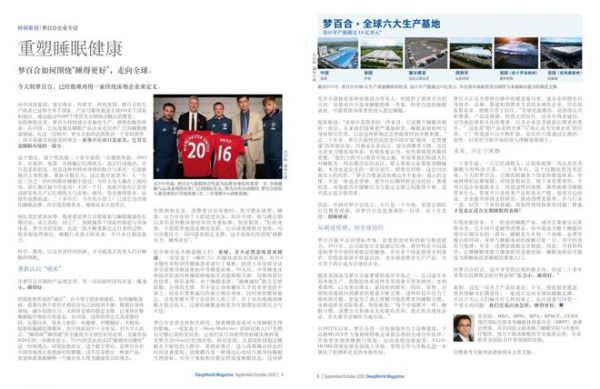
Special Report: "Reforming Sleep Health, How MLILY Dreamland is Striving for 'Better Sleep' and Heading to the Global Market"
Dispelling the Myth of 'Hard Beds Protecting the Waist': Clinical Research Evidence from Home and Abroad
The author of the special report, Li Qiyang, holds three international clinical professional qualifications: the American Board Certified Polysomnographic Technologist (RPSGT), the Registered Sleep Technician (RST), and the Clinical Sleep Health Certification (CCSH). He is currently a member of the Board of Directors of the International Board of Registered Polysomnographic Technologists (BRPT), the Chairman of the Continuing Education Committee, and the Chairman of the International Committee. He also serves as the Vice Chairman of the Sleep Medicine Professional Committee of the China Non-public Medical Institutions Association. He has been deeply involved in clinical services in sleep medicine, professional talent training, and international education certification system construction for a long time, dedicating himself to promoting the construction of the sleep medicine discipline, the development of professional talents, and international exchanges and cooperation in the Asia-Pacific region.
In the special report, Li Qiyang introduces that in Europe and North America, consumers tend to discuss mattresses from the perspective of body type, sleep position, pressure distribution, and personal comfort when discussing mattresses. However, in China, the concept that "the harder the bed, the better it is for the waist" is very common. He points out that according to a survey conducted by iiMedia Research, a well-known third-party industrial research institution, in 2024, 75.1% of respondents agree with the traditional view that "sleeping on a hard bed is good for the waist."
The special report cites a randomized, double-blind, controlled clinical trial published in The Lancet to verify whether this view is scientific: the study included 313 participants with chronic non-specific low back pain, who were observed using hard and medium-hard mattresses. After 90 days of follow-up, it was found that the participants using the medium-hard mattress had better improvement in bedtime pain and pain-related functional impairment than the hard mattress group.
Li Qiyang summarized this as: "This study shows that for sleep surfaces, 'the harder, the better' lacks sufficient evidence. Reasonable support is not about lying on a flat surface with almost no deformation, but about adapting to the body where it needs to be relieved while maintaining overall stability. Overly hard does not equal good ergonomics. For those with pain or unstable sleep, an overly hard sleep surface may even increase local pressure and discomfort."
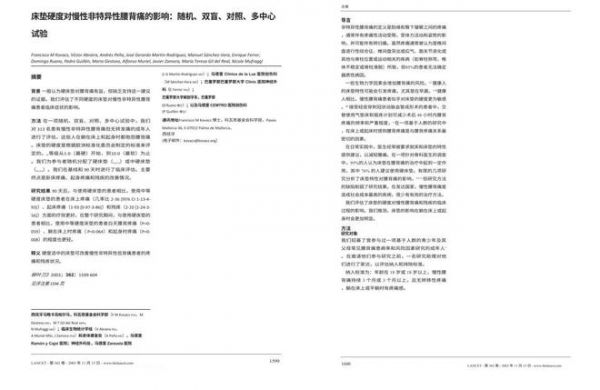
Lancet Paper: "The Impact of Mattress Hardness on Chronic Non-specific Low Back Pain: A Randomized, Double-blind, Controlled, Multicenter Trial"
The special report also cited an observational study published in the SCI journal Sleep Medicine, which included 117 participants and tracked changes in sleep physiological indicators before and after the participants changed their sleep surfaces. This study was supported by the Chinese sleep home brand MLILY Dreamland and was jointly conducted by Harvard Medical School, Dalian Weitao International Hospital, and the School of Science, Beijing Jiaotong University. The aim was to explore the impact of mattress softness and hardness on user sleep quality from a clinical perspective. The results showed that participants with poor sleep stability were able to enter a relatively stable deep sleep physiological state faster after replacing their daily hard mattress with a medium-hard MLILY memory foam mattress.
"This study provides a direction worth paying attention to: the mattress may not be the only answer to deep sleep, but a more suitable sleep surface may help the body enter a stable sleep faster," Li Qiyang said.

Sleep Medicine Paper: "The Impact of Different Mattresses on Sleep Quality in Healthy Participants: A Study Based on ECG"
Many domestic experts and scholars have also expressed similar views. Zhang Bo, a deputy chief physician of the Orthopedics Department of the Affiliated Union Hospital of Tongji Medical College of Huazhong University of Science and Technology, once publicly stated: "A good mattress should do two things: first, it should fit the body curve and not allow any part to hang in the air; second, it should distribute pressure and not allow any part to bear excessive pressure." Zhang Bo said that a medium-hard mattress is the most beneficial to sleep health, and the "China Expert Consensus on the Rehabilitation Treatment of Lumbar Disc Herniation" issued by the China Medical Association Rehabilitation Physicians Branch also clearly proposes that a medium-hard mattress should be the first choice.
Industry Perspective: Discussing the Role and Dilemmas of Enterprises in Participating in Sleep Popular Science Education - Taking MLILY Dreamland as an Example
However, despite the continuous verification by clinical research that "hard beds are good for the waist" is not scientific, there is still a large gap in the public popular science of sleep-related health knowledge in China. Li Qiyang said: "Science, education, and responsible innovation are the only way to truly change people's understanding of sleep." In recent years, China has accelerated the construction of sleep health. In 2025, the National Health Commission issued "Core Information and Interpretation of Sleep Health," guiding the public to establish a scientific sleep concept. The same year, the National Health Commission issued "Notice on Implementing the Realistic Projects of the Health System Serving the People in 2025," urging secondary and above public mental health hospitals to set up sleep clinics; general hospitals, traditional Chinese medicine hospitals, and other medical institutions to create conditions to set up sleep clinics; and the goal is to have at least one hospital providing sleep clinic services in each city, while also requiring the enrichment of personnel and strengthening of talent training for sleep clinics.

However, the industry普遍认为 that popular science education on residential sleep environment for ordinary consumers is still a weak link in health popularization work. As a high-frequency contact sleep product at home, how the mattress affects the human body's nocturnal physiological state is worth more clinical research and public communication. In addition to medical institutions and research institutions, commercial enterprises are also potential participants in public sleep popular science. This special report of SleepWorld Magazine takes the Chinese mattress brand MLILY Dreamland as an interview case to discuss the possibility and practical difficulties of industry entities participating in sleep science education.
As one of the earliest Chinese home appliance companies to go abroad, MLILY Dreamland has sold its products to more than 100 countries and regions around the world after more than 20 years of global layout. It has a large number of channel terminals and users in Europe and America, and has gradually gained trust in the global market through commercial integrity, respect for local laws and culture, and long-term social responsibility. This is why MLILY Dreamland was selected as a reporting case by the American professional journal SleepWorld Magazine.
MLILY Dreamland has supported a series of sleep clinical studies, including the above experiment published in the SCI journal Sleep Medicine, and is committed to promoting consumer education through scientific research and has been carrying out public communication related to sleep popular science for nearly twenty years. It directly calls for: "Don't sleep on a hard bed."
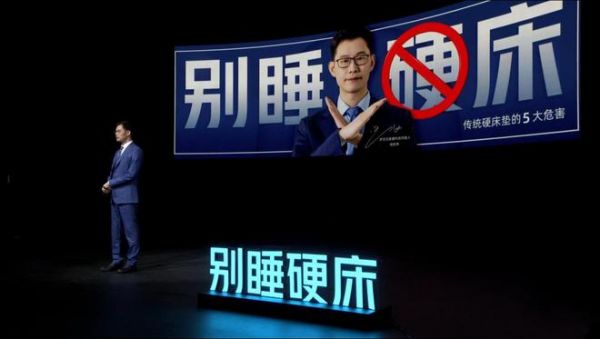
Li Qiyang believes that "in China, such an idea update particularly needs time," which means that for a commercialized enterprise, it needs to pay a lot of time, money, and opportunity cost.
In an interview, Ni ZhenGen, the founder of MLILY Dreamland, said that catering to consumer habits is often easier than changing habits, but some things are worth doing more slowly: "We can certainly go along with the market, but if we know that people have some long-existing misconceptions about sleep, then helping everyone to understand sleep better is also part of the responsibility of the enterprise. Even if sometimes, this will pay a commercial cost."
"The mattress should not be simply regarded as a piece of furniture, but as an important part of the complete sleep environment," said Ni ZhenGen since the brand was established. MLILY Dreamland has been committed to promoting market public education on "Don't sleep on a hard bed," but this process has been slow and difficult. Because of refusing to produce and sell hard mattresses, MLILY Dreamland has long relied on overseas performance to support its operations at home, and Ni ZhenGen himself has been described by the public as an "industry maverick" and "leader in adversity."
For many years, Ni ZhenGen has continued to call for more同行 and industry participants to join in promoting public education on sleep health, spreading scientific concepts based on clinical research, and even though popular science education requires a higher time cost, it is beneficial in the long run to improve the national health literacy of sleep and promote the sound development of the entire industry.
Industry experts say that the development of the sleep industry in the future cannot only focus on manufacturing and product iteration, but also needs to promote the linkage of medical research, industrial practice, and public popular science. When material science, long-term sleep observation, and health research are gradually connected, the sleep surface may also become an important entry point for understanding and improving sleep.
This article is a comprehensive compilation of the special report in the September-October 2026 issue of the American SleepWorld Magazine. Some of the observational studies in the special report were supported by MLILY Dreamland; the literature citations of the clinical trials mentioned in the text can be found in the reference list of the original publication. The interview content is from the special interview material.
相关知识
美国睡眠医学杂志《SleepWorld Magazine》专访梦百合:硬床护腰缺乏科学依据
321世界睡眠日,梦百合举办“别睡硬床”发布会
梦百合“100万张硬床垫改造计划”强势开启,告别硬床睡眠时代
MLILY梦百合召开“别睡硬床”发布会,发布“正确睡眠观”
梦百合“别睡硬床”运动在上海环球港启航
MLILY梦百合举办青少年系列新品发布会,呼吁“关爱孩子,别睡硬床”
梦百合梦粉节启幕:深耕睡眠服务链路,智床普惠加速
321 世界睡眠日,梦百合倪张根再次呼吁“别睡硬床”
梦百合倡导“别睡硬床”:一场关于睡眠的觉醒运动在上海环球港启幕
虎啸奖年度品牌人物倪张根:17年呼吁“别睡硬床”,把梦百合床垫卖向全球
网址: 梦百合硬床护腰:缺乏科学依据?美国杂志专访揭秘 http://www.jiajubaike.cn/newsview156711.html
推荐即时动态





- 1自建房造价多少钱一平米 2 24995
- 2重磅出击▏欧嘉全屋定制荣获“ 17289
- 3属鼠和属兔的合不合 属鼠的和 16417
- 4大角鹿瓷砖 8438
- 5天天315,品质365!看联 6230
- 6卢森地板2022新品触感系列 6182
- 7骊住水科技第四届进博会访谈实 5710
- 8爱情数字代表的意思大全 恋爱 5696
- 9属鸡男与属鼠女相配吗 属鸡男 5035
- 10世外康养 设计中国度假式居家 4896