“突破边界”:UPVC高性能复合材料新篇章
Understanding High-Performance UPVC Windows
For a long time, Chinese consumers understood plastic steel windows through a very straightforward structure: plastic profiles with a steel liner inside.
The name itself even explained the product. Plastic is responsible for insulation, while steel is for reinforcement, combining the two materials into a window.
Today, high-performance UPVC has far exceeded this simple illustration.
Arute's current Energeto 8000 uses powerdur composite material instead of traditional steel liner to reduce thermal bridges formed by steel, while maintaining the profile reinforcement; some other products use steel, aluminum, and U-PVC composite. Different products adopt different reinforcement methods, indicating that the industry is re-examining a fundamental issue: how should UPVC windows obtain structural strength?
"The question of 'with steel or without steel' is too simplistic. Technological progress often begins with rearranging the tasks of each material.
Steel liner solves problems, but also brings problems
UPVC is an excellent material for windows due to its low thermal conductivity, multi-chamber design, and weldability. However, the window frame must withstand wind pressure, glass weight, hardware pull, and long-term opening and closing, especially when the opening sash becomes larger. Relying solely on polymer profiles does not always meet the structural requirements.
Therefore, steel liner has become the most common reinforcement method for traditional plastic steel windows. It is mature, reliable, and can significantly improve the stiffness of the frame and sash. The problem is that steel has a much higher thermal conductivity than UPVC, and continuous steel liner will add a new heat transfer path inside the low thermal conductivity profile; if the thickness, shape, connection, and corrosion protection of the steel liner are insufficient, the structural advantage cannot be fully utilized.
Composite reinforcement materials try to obtain stiffness with lower thermal conductivity, while aluminum can combine exterior protection, color, and structure. Each route has its own limitations: composite materials need to verify long-term mechanical properties and connection technology, aluminum materials need to handle thermal bridges and expansion of different materials, and steel needs to find a reasonable position between insulation and structure.
Therefore, high-performance UPVC should not be defined by whether it has a steel liner or not. It should be defined by the load path, thermal performance, material durability, and overall window manufacturing.
Jingjing does not let one material handle all the problems
Jingjing's UPVC product matrix provides an interesting example.
In its research and development logic, UPVC first takes on the value of low thermal conductivity, multi-chamber design, and formula design; steel, aluminum, ASA, nylon, glass, and hardware are added according to product scenarios. The number of materials itself does not matter; the key is who solves the correct problem in the correct position.
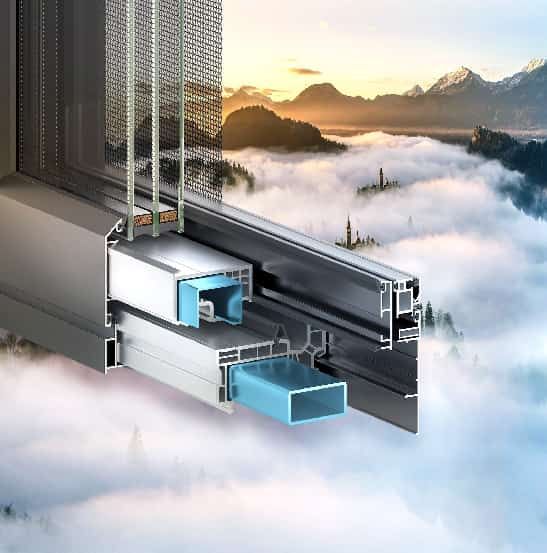
The Titan uses an inner and outer aluminum alloy and a middle ASA/UPVC polymer combined fourth-generation co-extruded profile system, and adds steel structure and super bridge design. The outer materials handle protection and surface treatment, the polymer is responsible for insulation, the steel handles structural reinforcement, and nylon participates in bridge connection. The key is not how many materials appear in the configuration table, but whether different materials form clear division of labor.
ONE and ONE+ use a 92mm fourth-generation ASA/UPVC multi-chamber platform, and use aluminum liner in the reinforced middle bar and other parts. It does not need to make the entire frame a metal structure, but adds capacity in the positions where the load is concentrated, while retaining the low thermal conductivity basis of UPVC.
Neo also uses 92mm fourth-generation ASA/UPVC and puts V perfect welding, rectangular steel middle bar, and U slot hardware into a flagship all-in-one platform. The formula solves long-term weather resistance, the steel middle bar handles structure, the overall transmission hardware coordinates locking, and welding and manufacturing ensure that these designs truly form a stable frame and sash.
The three product routes do not provide a unique material answer, but together reflect Jingjing's core research and development method: first define performance and scenarios, then reverse select materials, structure, hardware, and technology.
Connecting multiple materials is truly difficult
Putting several good materials together does not automatically result in a good window.
Steel, aluminum, and polymers have different thermal expansion, stiffness, surface treatment, and processing methods. When the temperature changes, the expansion of each material is not consistent; when subjected to force, the load must be transferred from one material to another at the connection point. If the interface,扣合, welding, fastening, and waterproofing are not systematically designed, multiple materials may increase the risk of loosening, noise, and water leakage.
Jingjing designs the profile, reinforcement, and hardware synchronously, and the value is here.
For example, the position of the hardware hole cannot only be found on the surface of the profile where a screw can be tightened, but also needs to enter the reinforcement structure and form a reliable connection; the glass weight cannot be suspended at one corner of the opening sash for a long time, but needs to be transmitted to the correct frame force path through bridge pads; the middle bar cannot only be seen as whether the cross-section is thick enough, but also needs to be considered for the connection parts, reinforcement, and overall window assembly.
These capabilities are difficult to fully demonstrate in an exploded view, but they determine whether the large window can open and close for a long time, whether it is stable under strong wind, and whether there will be changes at the connection points after many years.
Unique structure will reverse change the factory
Another often overlooked threshold for multi-material products is manufacturing.
Traditional equipment is usually designed around standard profiles and mature processes. When new co-extruded surfaces, reinforcement forms, hardware interfaces, and composite connections are added to the product, general equipment may not be able to directly complete them. Relying on a large number of manual adjustments can produce a small number of sample windows, but it is difficult to support stable delivery in the national market.
Jingjing's approach is to let the product change the software and equipment.
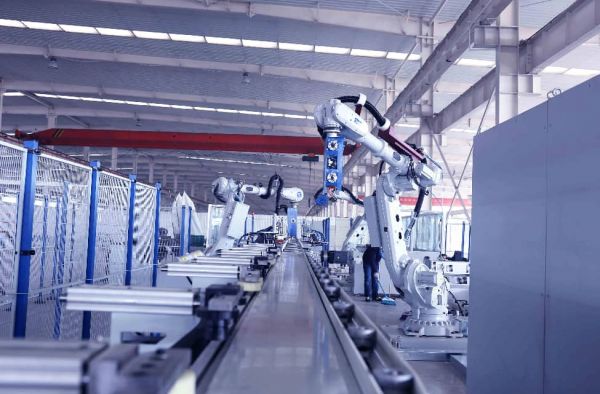
Jingjing's cloud platform first forms rules for the profiles, reinforcement, glass, hardware, and processes of different products. After the order enters the factory, ViewMax iMES continues to dispatch processing and production tasks, and the self-developed UPVC core equipment, robot production line, automatic rolling, automatic cutting of wire, and AI quality inspection undertake specific manufacturing.
When the profile structure changes, the enterprise can modify the process database and equipment logic; when complex products expand, the system can also copy the design requirements stably to more orders. Material research and development, product research and development, and manufacturing research and development form a closed loop.
This is the most difficult part of Jingjing's core strength that is hard to imitate simply. Others can buy similar materials and refer to a certain section, but to make a complex structure from design, quotation, BOM to automated manufacturing, it requires long-term accumulation of software, equipment, process, and data.
High performance does not have a unique material answer
The window industry often seeks a simple answer: is aluminum good or plastic good, is there steel good or no steel, and is thicker material safer.
The engineering world is rarely so simple.
Materials are just tools. Low thermal conductivity, structure, protection, weather resistance, sealing, lighting, and opening each put forward different requirements. The real ability of enterprises is to understand the conflicts between these requirements and achieve a balance with appropriate materials and system design.
The boundary of high-performance UPVC is being expanded. What drives the change is not some new material that handles everything, but the fact that enterprises are beginning to rearrange the relationships between materials.
Jingjing goes a step further. In addition to material combinations, it also studies how hardware enters the profile, how glass weight is transmitted, how software understands orders, and how equipment manufactures unique structures. What consumers ultimately get is a complete window that can be used for a long time.
From no steel liner to multi-material composite, the industry explores different technical routes; from material to whole window to manufacturing, Jingjing has established a set of continuous generation of new routes.
相关知识
从无钢衬到多材料复合,高性能UPVC的边界正在被推开
塑钢窗退潮之后,极景为什么仍然押注UPVC
科饶恩门窗:开启UPVC门窗行业的新时代定义!
又要搞事?富轩门窗率先破卷推出UPVC系统门窗,开辟节能门窗新赛道!
2024中国(高碑店)国际门窗博览会,科饶恩门窗与您共探UPVC门窗发展新机遇!
联塑班皓发布自主研发新型复合材料太阳能组件边框,引领行业降本增效新风尚
富轩门窗率先推出第四代节能门窗“UPVC系统门窗”,正式发动门窗节能革命!
塑钢窗后,极景如何持续看好UPVC
联塑班皓发布复合材料边框组件,创新助推光伏行业降本增效
建博会聚焦UPVC,门窗行业新动向探析
网址: “突破边界”:UPVC高性能复合材料新篇章 http://www.jiajubaike.cn/newsview152949.html
推荐即时动态




- 1自建房造价多少钱一平米 2 24995
- 2重磅出击▏欧嘉全屋定制荣获“ 17289
- 3属鼠和属兔的合不合 属鼠的和 16417
- 4大角鹿瓷砖 8438
- 5天天315,品质365!看联 6230
- 6卢森地板2022新品触感系列 6182
- 7骊住水科技第四届进博会访谈实 5710
- 8爱情数字代表的意思大全 恋爱 5696
- 9属鸡男与属鼠女相配吗 属鸡男 5035
- 10世外康养 设计中国度假式居家 4896